
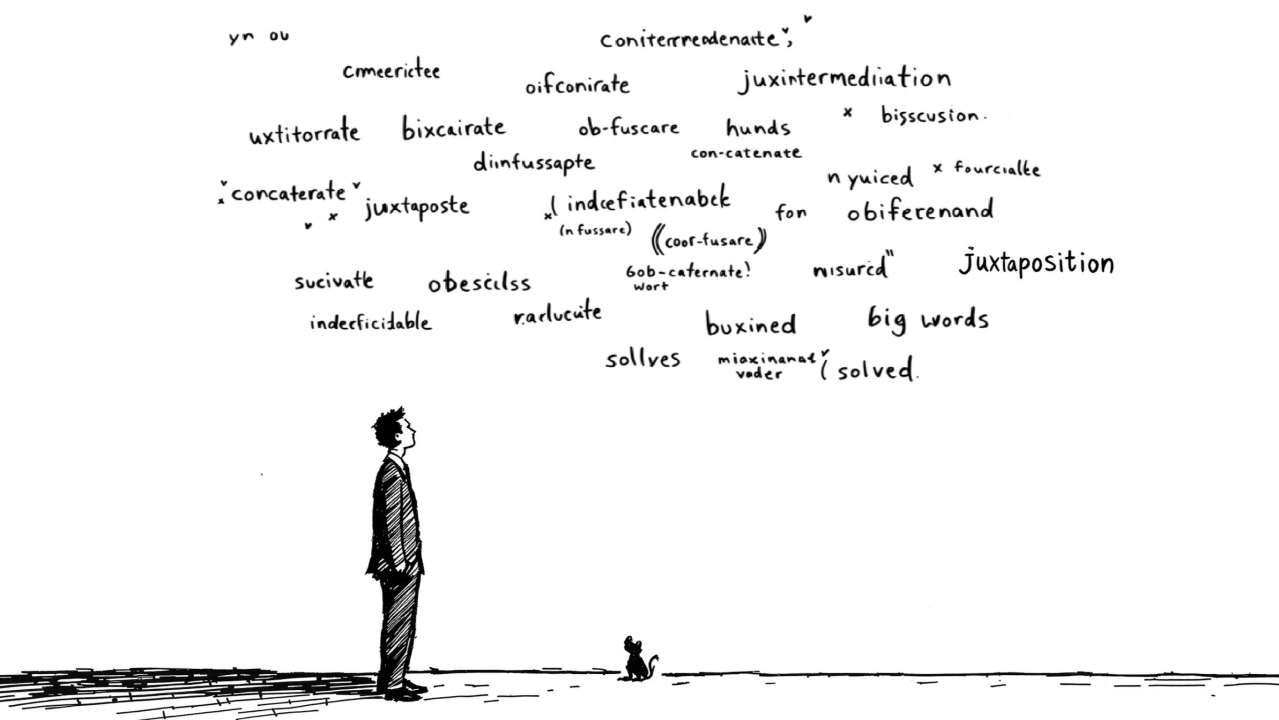
When Big Words Get Less Scary (But One Should Still Terrify You)
January 26, 2026
As an engineer, I lived happily in a world of specifications, APIs, and stack traces. Words either compiled or they didn’t. Simple.
Then I started my MBA. This was a long, long time ago now.
Suddenly I’m surrounded by people casually throwing around “disintermediation” and “ameliorate” like they’re ordering coffee. I’d hit these words in case studies and just… gloss over them. Context clues, right? Sounds business-y. Moving on.
Week three is burned into my memory – and not in a good way. I’m in a strategy discussion, and someone asks me to “juxtapose the two frameworks.” I panicked. Is that… a math thing? A positioning thing? I mumbled something vague – a technique I’d later discover the textbook called “strategic ambiguity” – and made a mental note: Learn the fancy words. Fast.
So, I did what any respectable grad student does – I Googled etymologies at 2 AM.
Turns out “concatenate” just means “chain together” (con + catena = with + chain). “Obfuscate”? Make dark (ob + fuscare). “Ameliorate”? Make better (melior = better). These intimidating monsters were just Latin LEGO blocks! “Disintermediation”? Remove the middleman. “Indefatigable”? Un-tire-able. I started practicing them in low-stakes emails, then meetings. Within a month, I was dropping “quintessential” and “ubiquitous” like I’d been doing it my whole life.
The engineering brain that loved breaking down systems suddenly loved breaking down words. Crisis averted.
But there’s one big word that should actually scare you: obsolescence. And unlike the others, understanding it won’t make it less scary.
My Gen-Z friends get this viscerally. Many of them learned to code in school, and now they’re watching AI write better code than most developers. They’re graduating into a world where the skills they mastered in year one are outdated by year four. The half-life of career skills is shrinking faster than anyone’s attention span on TikTok. Every six months there’s a new framework, a new “essential” tool, a new methodology you’re supposed to master or risk being left behind.
Sounds familiar?
That’s why I’m determined not to be written off to obsolescence. I keep learning. Keep adapting. Because I’ve seen what happens when you don’t – you’re the frog in boiling water, and by the time you notice, the industry’s moved on without you.
Here’s the brutal truth about obsolescence – it’s everywhere, and it’s expensive. Your iPhone? Obsolete in 3 years. Your car’s fancy tech? Outdated before the loan’s paid off. Some companies are still propping up Windows XP installations under all kinds of pretexts. That enterprise software your company spent six months evaluating and six figures buying? Already limping toward its replacement date.
And replacement isn’t just expensive in dollars – it’s expensive in disruption. The migration projects. The data cleanup. The retraining. The inevitable “why doesn’t this work like the old system?” complaints that haunt IT departments for years. The consultants who charge premium rates to fix what broke during the transition.
This is exactly why I chose to build ShowCycle on Salesforce. The platform that powers a third of the world’s CRM isn’t going obsolete. It evolves continuously. Updates arrive automatically. Your event management system rides those innovation waves instead of drowning in them.
Those big MBA words I learned a long time ago? I can choose when to use them. But obsolescence? That’s not optional – it’s coming for your systems whether you’re ready or not.
And if you run events, make ShowCycle the last event software decision you ever make. Because the scariest word in business isn’t “obfuscate.”
It’s “migration.”
What skills or systems are you future-proofing right now? And do you know of any outrageous obsolescence situations you’d like to share?